D. W. Griffith's film A Corner in Wheat was released on December 13, 1909— one-hundred years ago today. This social commentary was based on source material from Frank Norris (the novelist whose McTeague became 1924s Greed). A Corner in Wheat is shown in film school classes and currently resides as the #1 film on IMDb's list of 1909 films by total votes.
Showing posts with label Directors: Others. Show all posts
Showing posts with label Directors: Others. Show all posts
Sunday, December 13, 2009

Tuesday, May 5, 2009
Coppola's "Tetro"
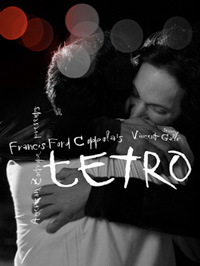
Probably another think-piece fizzle from Coppola-- but you never know. I'd prefer he keep "experimenting" rather than just turn out some "safe" genre piece. But, I'm still gonna wait to hear what the critics say before going to it.
Link to first ten minutes of Tetro.
Saturday, February 14, 2009
The "Turn off Your Cell Phones" of 100 Years Ago
What was the big gripe at the movies 100 years ago? It's answered in D. W. Griffith's now-century-old short film Those Awful Hats.
Saturday, August 23, 2008
William Friedkin Interview with Fritz Lang
Someone has recently posted on YouTube a filmed interview that William Friedkin did with Fritz Lang. The interview was done in 1974 according to Imdb, and 1975 according to the poster. Either way, Lang died in 1976, so this was done shortly before his death. There are five ten minute segments posted, below is the first.
Monday, May 5, 2008
Kevin Brownlow Speaks on "Napoleon" (1927) and D. W. Griffith's Legacy
 Silver Screen Oasis had Kevin Brownlow as a guest on their message boards (from London) and the discussion was so interesting and chock full of information that I printed the whole thing out for future reference!
First of all Brownlow says on the long awaited DVD release of Abel Gance's Napoleon (1927) that "I think a compromise has been reached" between the parties involved with the two warring sides of the films' score. I really hope this is true— it's easily one of the few great masterpieces yet to be released on DVD.
Brownlow takes on D. W. Griffith. He notes that Griffith made some bad films indicating One Exciting Night, Dream Street, and Scarlet Days. I've seen all three of these Griffiths (believe it or not) and they are definitely his worst; Scarlet Days was a particular disappointment because it's really hard to find (Griffith's only western feature). Brownlow discusses the maligned Birth of a Nation. He acknowledges it's groundbreaking techniques and also it's overt racism ("... in the second half you get the hair-raising racism"). His comments on it should be read completely if you're interested. He notes something that I've never heard before— that Griffith made a film called Rose of Kentucky, in which the KKK were the villains and an African-American boy was the hero. According to silentera.com, the survival status of this 1911 film is unknown.
Browlow mentions a silent film out on DVD that I've been meaning to catch up with: "I just showed some silents in Ireland and while the audience loved them all, they were particularly impressed by an almost-forgotten French silent called Children's Faces (Visages D'Enfant). Highly recommended; one of the finest films about children..." Well this has now been bumped up on my list of films-to-see. (Brownlow gives examples of many other obscure silents he feels are masterpieces as well...)
Here's a link to the boards.
Sunday, April 27, 2008
TCM Premieres Abel Gance Films
 As I noted in a blog entry in November, two Abel Gance silents have been restored. The two epic films are being shown on TCM tonight, plus a one-hour documentary. I plan on watching at least the 2.5-hour-plus J'Accuse (1919) [still photo, left] which has been on my must-see list (I could never find it— now I'm glad since any version previous to this would have been a greatly mutilated cut): I'll offer my thoughts in my April end-of-the-month wrap-up.
The films come out on DVD May 5th (La Roue) and September 2 (J'Accuse).
La Roue Amazon link.
Flicker Alley website.
Saturday, December 29, 2007
This Month on TCM: Top Hat (1935)
 On Monday, December 31st, TCM is showing several Fred Astaire/Ginger Rogers films, including the Mark Sandrich classic Top Hat, their first "starring" vehicle (following their successful teaming in Flying Down to Rio).
Every Astaire-Rogers film opens great, but Top Hat has the best (albeit simple) opening titles and fanfare of them all, brilliantly juxtaposed with the first scene (a quiet sitting room at a men’s club). Astaire’s disruptive tap at the end of this scene is a memorable laugh. There's a delightful first song (and tap dance) for Fred (“I’m fancy free and free for anything fannnncy”) that includes a terrific “pan” down to the room below introducing Ginger in bed, woken up by the activity, followed by a clever soft-shoe (Astaire’s character uses sand from an ash can).
 The film is about an American dance man named Jerry Travers in London falling for a young lady named Dale Tremont, who, after falling for him, believes she has discovered that he’s a married man. Following the mistaken-identity, Ginger gives Fred a slap— and his reaction is priceless. Astaire and Rogers give among their best performances in this film and they are brilliant in a scene where each pretends to have met the other in Paris (first Dale has the upper hand, then Jerry). “Cheek to Cheek” is possibly the greatest song in any Astaire-Rogers film (even if it did manage to lose the Oscar). Their subsequent dance (memorable for Rogers’ feather dress [see photo]) is superb, particularly in light of the way their characters are feeling about each other at the time. Other top-notch sequences include the gazebo scene (where Dale falls for Jerry), which is sweet and irresistible (“Isn’t this a lovely day to be caught in the rain?”) and serves as the perfect dance interpretation of a courtship: each showing off for the other, the occasional misstep, then perfect sync. Handsome cab sequence with corny jokes (“What is this strange power you have over horses?”/ “Horsepower.”) that precedes it, is, thankfully, short. “Top Hat, White Tie, and Tails” tune and dance, with tuxedoed back-up dancers, is classic, integrated into the movie as part of Jerry’s stage show (especially fun is Astaire’s tapping as gun fire, using his cane as a rifle to “shoot” down the other dancers).
 The supporting actors are always fun to watch in the Astaire-Rogers movies. Edward Everett Horton (as Horace Hardwick, the producer of Astaire’s show) and Eric Blore (as his valet) are hilarious in their tete-a-tetes. Helen Broderick (as Horace’s wife Madge), appearing in the film’s second half, is particularly funny in her scene where Ginger tells her of her husband’s supposed infidelity (“He chased me in the park.”/ “Really, I didn’t know Horace was capable of that much activity… Did he catch you?”/ “Yes.”/ “Good for Horace!”). Final third of the movie offers a little too much explanation, slowing the film down, but it’s rescued by “The Piccolino” number (“By the Adriatic waters, Venetian sons and daughters are strumming a new tune upon their guitars…”).
Top Hat (1935): Fred Astaire and Ginger Rogers give their finest performances among their vehicles, evidenced best by their dancing and acting in the show stopping "Cheek to Cheek"; several other top notch Irving Berlin songs ("Isn't This a Lovely Day (to be Caught in the Rain)," "The Piccolino," "Top Hat, White Tie, and Tails") and the usual funny supporting actors make this one of the team's most outstanding films, if its final third drags a bit.
Sunday, December 2, 2007
"All Quiet on the Western Front" (1930) First Kudos King
 As we're just about to embark on another Awards Season (with Wednesday's announcement of the National Board of Review's picks for the year), its worth commenting on the importance of film awards in general. Everyone who loves the Oscars seems to realize that they're best appreciated when not taken too literally as acknowledgement of the best artistic acheievements of the year. With that said, what merit do they have? My opinion of the Awards season in general is that the Oscars are best at acknowledging movies that were either the cultural landmarks of each year (Gone With the Wind, Platoon, Titanic) or movies that were made against-all-odds (nominee Star Wars, Dances With Wolves, nominee Little Miss Sunshine). The critics, particularly the New York Film Critics Circle, acknowledge the best artistic achievements with not as much concern for epic scale or production backstory (such as the New York Critics picks: Five Easy Pieces, Hannah and Her Sisters, and Mulholland Drive) [although the New York Critics have awarded quite a few epic productions through the years].
 If taken together, all these groups do provide a shortlist of movies for the filmgoer to see that have historically been the best films of the year. Take for example just the winners of the Best Picture Awards in 1974:
National Board of Review: The Conversation
New York Film Critics: Amarcord
National Society of Film Critics: Scenes From a Marriage
Golden Globes: Chinatown (drama); The Longest Yard (comedy or musical)
Academy Awards: The Godfather, Part II
And even when none of the groups pick the films that are later acknowledged as the best of their year, even that becomes something of interest. Alfred Hitchcock and Orson Welles are certainly considered two of the very best film directors of all time and yet both made what many consider among their greatest films in 1958, Vertigo and Touch of Evil, respectively— neither of which got awards attention.
Where did it all begin? Michael Gebert's The Encyclopedia of Movie Awards points to Photoplay magazine (and its Medal of Honor award) of the 1920s as among the first award-givers out of the kudos gate. Trade publication Film Daily polled hundreds of film critics for its annual top ten which started in 1922. The Oscars were first given out in 1929 (for films released between August 1927- July 1928).
The first film to sweep the top prizes and numerous groups since the inception of the Academy Awards appears to have been director Lewis Milestone's All Quiet on the Western Front. It won the Oscar for Best Picture, was voted one of the top ten Best (American) films by the National Board of Review (they did not distinguish a #1), received Photoplay's Medal of Honor Award, and topped Film Daily's poll of the ten best films of the year.
All Quiet on the Western Front (1930): Story and camerawork are first rate in this important antiwar classic which is flawed only by the limitations of early talkie technology.
Saturday, November 24, 2007
"J'Accuse" (1918) and "La Roue" (1922) to be Released on DVD
 Director Abel Gance gave the world one of the greatest silent films, 1927's epic Napoleon, which has seen celebrated theatrical, TV, and video exposure. However, little has been seen of his other silent films. At the tail end of an interview with Film Threat, Jeff Masino offered the news that his company, Flicker Alley, whose releases include the classic French silent serial Judex, is planning to release new digital editions of both Gance's antiwar J'Accuse (1918) (still above) and landmark drama La Roue (1922). The restoration is being carried out by Netherlands Filmmuseum, Lobster Films in Paris, Film Preservation Associates, and others. The films will feature scores composed by Robert Israel.
Both J'Accuse and La Roue were widely seen and influential films in their day.
Napoleon itself has not seen DVD-- perhaps it too is on the way.
Friday, November 23, 2007
Writers Guild Strike 2007, Week Three

The Writers Guild Strike continues, but with a glimmer of hope, as the guild and the studios return to the bargaining table on Monday. In the meantime, several studio films have been put on hold until the strike is over, including the following:
Pinkville: Oliver Stone's film about the My Lai Massacre, starring Bruce Willis had a December start date that has been postponed.
Angels & Demons: Ron Howard's follow-up to The Da Vinci Code, based on Dan Brown's prequel, is on hold since Akiva Goldman's script still needed work and he's on strike. The movie's release date has thusly been pushed from late 2008 to sometime in 2009.
Shantaram: Mira Nair's film with Johnny Depp slated to star, was to begin filming in February, but the production start date has now been called off.
Nine: Rob Marshall's film with Penelope Cruz, Javier Bardem, Sophia Loren, Marion Cotillard had its March start date postponed.
Wednesday, November 21, 2007
Henri-Georges Clouzot Centenary
 The 100th anniversary of French film director Henri-Georges Clouzot's birth was yesterday, November 20th; he died in 1977. Clouzot's reputation in film mostly centers on his two 50s thrillers The Wages of Fear (1953) and Diabolique (1955). The Criterion Collection offers both of these films on DVD as well as his 40s efforts Le Corbeau (1943) and Quai des Orfevres (1947). Among his other noteworthy films is the feature-length documentary The Mystery Of Picasso (1956).
Clouzot was known as a perfectionist; like Hitchcock, he both sculpted his scripts and planned his shots during pre-production meticulously. Ill health throughout his life limited the number of feature films he made to about a dozen.

The Wages of Fear won both the Grand Prize (later known as the Palme d'or) at Cannes and the Golden Bear at the Berlin Film Festival. Bosley Crowther ended his New York Times review of the film thusly: "The excitement derives entirely from the awareness of nitroglycerine and the gingerly, breathless handling of it. You sit there waiting for the theater to explode."
The Wages of Fear (1953): A devastating study of human nature, this movie hits you right between the eyes with what we’re all capable of, depending on the circumstances, not the least of which is courage but most frighteningly, a willingness to forget your own humanity; a despairing look at our own individual, selfish psyches presented in the form of a suspenseful thriller.
Tuesday, November 20, 2007
The "Munchkins" Get A Star on the Hollywood Walk of Fame

Seven of the nine surviving Munchins from The Wizard of Oz were presented with the 2,352nd Star on the Hollywood Walk of Fame today. Present were Mickey Carroll, Ruth Duccini, Jerry Maren (holding lollipop in photo, as he was one of the "Lollipop Guild" in the movie), Margaret Pellegrini, Meinhardt Raabe, Karl Slover and Clarence Swensen. A crowd of photographers, cameramen, and onlookers filled the sidewalk outside Mann's Chinese Theater to watch Hollywood Mayor Johnny Grant present the star after the group of Munchkin actors walked down a mock Yellow Brick Road. When the actors spoke they were greated with enthusiasm by the crowd, as when, for example Meinhardt Raabe recited his famous lines from the movie: "As Coroner, I must aver I thoroughly examined her. And she's not only merely dead, She's really, most sincerely dead.”

Mann's Chinese Theater was done up right with multi-color balloons strung overhead in the shape of a rainbow. Also present were several other stars of the Hollywood era with a connection to the event, such as Margaret O'Brien (former child star who appeared with Judy Garland in Meet Me in St. Louis) and Ann Rutherford (who appeared in another 1939 MGM release— Gone With the Wind).
Its amazing that a campaign was necessary to get the Munchkins their deserved Star (link: KNBC story), in light of the fact that the Munchkins are probably more famous than just about anyone who has a star. I'm reminded too of the great efforts by author/researcher Stephen Cox, whose book The Munchkins of Oz (now in its third edition but originally published in 1989), set the record straight on the credits for the little people who are merely credited as "The Munchkins" in the movie. Had Cox not done the research in 1988-89, such an effort would have been impossible today.
The Wizard of Oz (1939): Judy Garland exudes sincerity as she convinces the audience that even if your life is in sepia, your dreams can still be in Technicolor, in a movie that will be watched and enjoyed literally forever.
Thursday, November 15, 2007
John Gilbert/King Vidor Silent Found; Much Sought-After Janet Gaynor/F. W. Murnau Film May Also be Extant
 Heard a rumor through the Association of Moving Image Archivists (AMIA) listserve that a 1926 John Gilbert film, Bardelys the Magnificent (an historical drama set against 17th century France and directed by King Vidor), has recently been discovered. This film is listed as one of the most wanted silents on silentera.com's website.
Additionally, Silentera.com has a link at the top of their site homepage to a very curious exchange that appeared on Criterion's Forum blog. Apparently a copy of the much sought-after film Four Devils (1929) might exist. This was F. W. Murnau's follow-up to Sunrise (which is often cited as the greatest silent film of all time). The film is about a trapeze act, two of whose members fall in love (played by Janet Gaynor and Charles Morton) but who are torn apart by the entrance of a "vamp" who tempts the male away (played by Mary Duncan)

A 1928 novelization of the film offers several stills (two I've posted here), which don't necessarily strike me as making for the best film (nor does the film's plot); however the historical value of the film alone would make it one of the film finds of the decade.
Monday, November 12, 2007
Last of the 1950s Oscar®-Winning Directors, Delbert Mann, Dies at Age 87

Delbert Mann (second from left, on the set of Marty) was the last of the 1950s Best Director winners alive. Now, the earliest Best Director winner (chrologically) still alive is Mike Nichols.
Earliest Ten Oscar-Winning Directors Alive (Chronologically by Year of Win)
1. Mike Nichols: The Graduate (1967)
2. William Friedkin: The French Connection (1971)
3. Francis Ford Coppola: The Godfather, Part II (1974)
4. Milos Forman: One Flew Over the Cuckoo’s Nest (1975)
5. John G. Avildsen: Rocky (1976)
6. Woody Allen: Annie Hall(1977)
7. Michael Cimino: The Deer Hunter (1978)
8. Robert Benton: Kramer Vs. Kramer (1979)
9. Robert Redford: Ordinary People (1980)
10. Warren Beatty: Reds (1981)
The age of Best Director winners must be going down, as every single winner from 1975 to the present is currently alive.
Only two Oscar-nominated directors from the 1950s remain: Michael Anderson (b. 1920) [Around the World in 80 Days] and Sidney Lumet (b. 1924) [12 Angry Men].
Here is a list of the 1950s Best Director Winners:
1950: Joseph L. Mankiewicz (1909-93): All About Eve
1951: George Stevens (1904-75): A Place in the Sun
1952: John Ford (1894-1973): The Quiet Man
1953: Fred Zinnemann (1907-97): From Here To Eternity
1954: Elia Kazan (1909-2003): On the Waterfront
1955: Delbert Mann (1920-2007): Marty
1956: George Stevens (1904-75): Giant
1957: David Lean (1908-91): The Bridge on the River Kwai
1958: Vincente Minnelli (1903-86): Gigi
1959: William Wyler (1902-81): Ben-Hur
Saturday, November 10, 2007
Dario Argento Poised for a Career Resurgence
 Film director Dario Argento, whose name is almost always preceeded with the words "Italian horror maestro," has made the last in his "Three Mothers" trilogy. The first was his masterpiece Suspiria (1977), his second, Inferno (1980), and now, after 27 years, is The Mother of Tears. This is the chronological equivalent of Return of the Jedi coming out this year.
 It was worth the wait. The film belies Argento's 67 years— it's a youthfully energetic film sure to widen his cult status. The University of Southern California (USC) presented The Mother of Tears on Friday night as part of a tribute to Argento, with screenwriters Adam Gierasch and Jace Anderson present. Gierasch gave an introduction in which he amusingly described how he lucked into the screenwriting job, a longtime fan who, through a loss in translation, went from asking Argento for an autograph, to landing a trip to Rome to co-write the movie.
The Mother of Tears does not try to mimic Suspiria (the tragic flaw of Inferno) and could easily stand on its own. And listen, Argento's films in general try my mainstream sensibilities to the breaking point, but there is something to his work and particularly the first, and now the third, of this trilogy.
Screenwriter Gierasch stated that there is an attempt being made to get The Mother of Tears into this January's Sundance Film Festival in anticipation of its US premiere. I suspect that the film will get a decent amount of play— at least a little more than one week at the Nuart in L.A. and the Angelica in New York— and might lead to a few screening series of Argento's films next year.
The "Three Mothers" trilogy:
Suspiria (1977): Atmospheric “fairytale” is at one with the groundbreaking horror films of its day, yet outdistances them with its striking visuals, shocks, and brilliantly maniacal musical score (if in exchange for a looseness of thematic resonance, other than the psychology of audience manipulation), creating an unsettling tone that is a combination of sound and image perfectly matched to make the viewer unsure of what they’re seeing and hearing.
Inferno (1980): All of the elements, as elements, that made Suspiria so fascinating are on display— the striking art direction/ cinematography, the mystery, the shocks, the unusual score— but each of them is drastically less effective, and even a richness of recurring motifs can’t save this entry from being a parody of style only worth the effort as a bridge between the trilogies' better two-thirds.
The Mother of Tears/La Terza Madre (2007/08): Energetic and ambitious film delivers crowd-pleasing (albeit frequently misogynistic) shocks and suspense and a journey narrative that taps into our innermost desire for the horror image.
Argento's imdb listing.
Subscribe to:
Posts (Atom)
